
Flooded


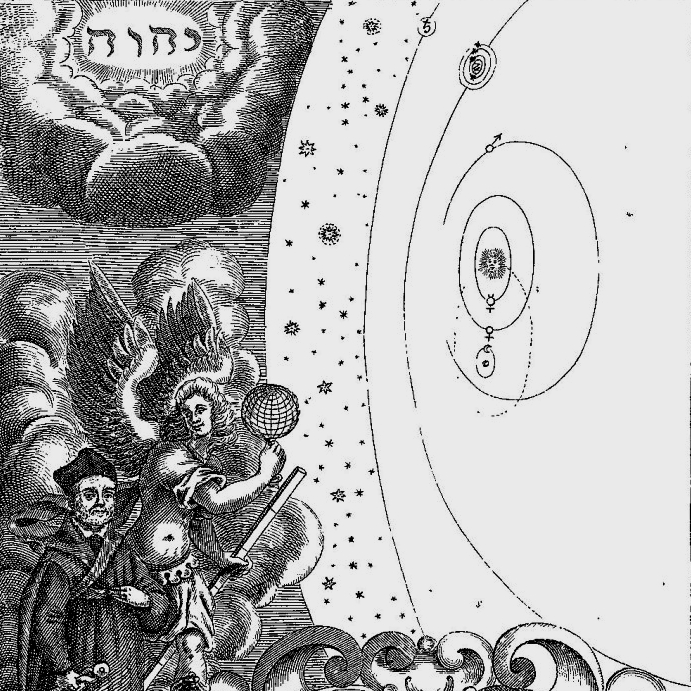
Athanasius Kircher – Kircher accompanied by the Angel Cosmiel on a Journey through the Cosmos, “Itinerarium Exstaticum”, 1671.
Exaggerations and even fabrications notwithstanding, Kircher wrote only one book that could rightly be called a work of fiction, and that was “Itinerarium Exstaticum” (Ecstatic Journey). At the time, Kircher wanted to enter the discussion about all the new astronomical observations afforded by the telescope, but an insufficiently critical treatment of the new astronomy could get you in trouble with the Inquisition, if not burned at the stake. So he wrote it as work of the imagination – the story of a Cosmic Dream in which an Angel named Cosmiel leads Kircher’s fictional stand-in, a priest named Theodidactus (“taught by God”), on an edifying flight through the Heavens.
There isn’t much doubt that Kircher privately believed in the Copernican model of the Universe, but his opinion wasn’t based solely on the astronomical evidence. A Sun-Centered System also made much more Mystical sense. “The whole mass of this Solar Globe is imbued with a certain Universal Seminal Power”, Cosmiel explains about the Sun. It “touches things below by radiant diffusion.”
Whatever else may be said about it, “Itinerarium Extaticum” represented a step toward modern science fiction. In fact, although Kircher’s scientific stature largely faded, his work influenced many writers and artists, including Sor Juana Inés de la Cruz, Edgar Allan Poe, Jules Verne, Marcel Duchamp, and Giorgio De Chirico.




 White Magic Studio
Recent Comments